

Share This Article
OnlyFans gives new fans two entry points: a free page or a paid subscription. If you are moving from browsing free pages to paying for one, the shift is mostly about billing mechanics rather than access alone. This guide walks through that upgrade path step by step, so you avoid double charges and know exactly what you get for your money. BestOnlyFans refreshes its rankings every month.
Most fans do not upgrade immediately. They follow a few free pages first, buy the occasional unlocked message, and only later test a paid tier. BestOnlyFans refreshes its rankings every month, and the sequence below follows the same subscriber arc its comparisons describe. The BestOnlyFans method stays consistent across updates.

The Typical Free-to-Paid Subscriber Journey
A fan discovers a page through a link, follows for free, and watches how often new posts appear. After a few unlocks, the question becomes whether a monthly subscription would cost less than repeated one-off purchases.

That comparison is where most people pause, because the two spending patterns work differently. Recognizing where you sit on the curve helps you decide when an upgrade is justified.
| Stage | Behavior Pattern | Typical Duration |
|---|---|---|
| Free discovery | Follows several free pages, no spending | Days to weeks |
| Selective PPV buyer | Unlocks occasional pay-per-view messages | Weeks to months |
| Evaluation period | Compares PPV totals against subscription price | One to four weeks |
| Paid trial | Buys a promotional first month at a reduced rate | One month |
| Committed subscription | Renews at the standard base price | Ongoing |
The stage that catches people out is the paid trial, because promotional pricing behaves differently from base pricing. OnlyFans allows first-month promotions below the standard minimum, so a page can open at a low introductory rate and then renew higher. Base prices themselves never sit below $4.99.
The transition also has a social dimension. Once a fan has interacted on a free page through comments or direct messages, the paid page feels like a continuation rather than a new purchase.

Evaluating Whether Paid Access Improves Value
It depends entirely on what the paid tier includes and how much you were already spending on unlocks. Run the numbers before committing rather than assuming the upgrade pays for itself.
- Is the core content included, or does most of it still sit behind pay-per-view?
- What PPV messages remain on the paid page, and at what prices?
- How frequently does the creator post on the paid tier compared with the free one?
- Is direct messaging included, or billed per message at typical rates of $3 to $5?
- What is the cancellation policy, and how much notice does it require?
On some pages, messaging runs $3 to $5 per message, and a long conversation can exceed the subscription cost within a week. If messaging is your main reason for following, that line item matters more than the base price.
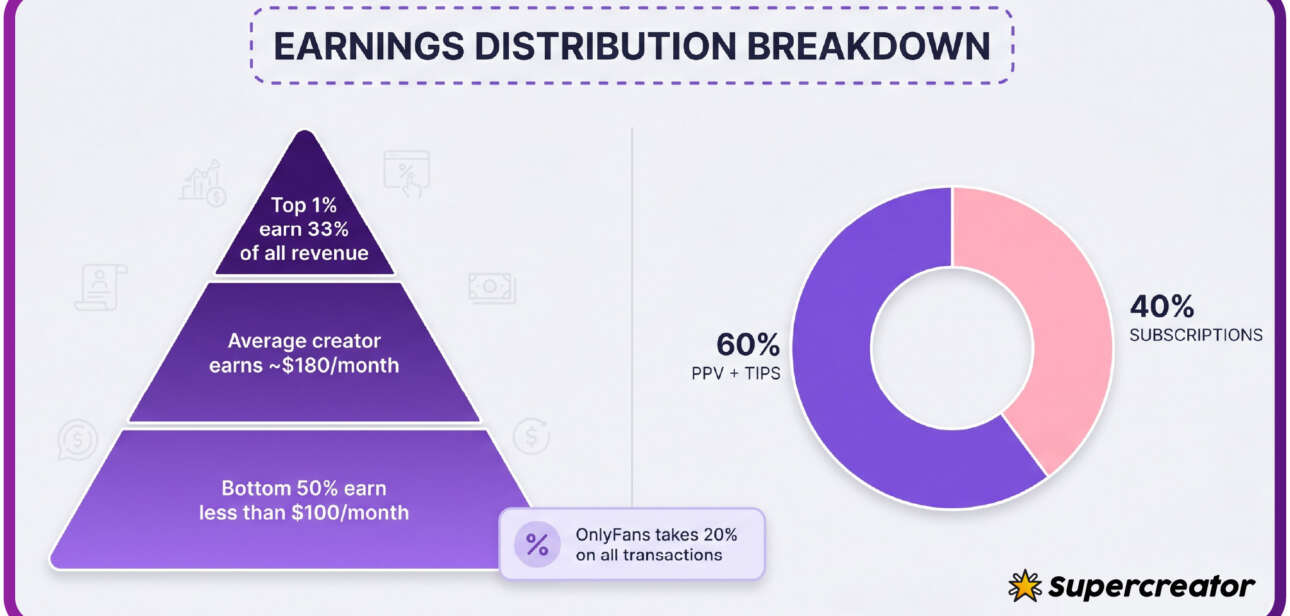
PPV unlocks on paid pages can reach $50 for a single message, and tips can run up to $100. A subscription removes the monthly access barrier but not those optional charges. The platform takes a 20% cut of everything, and the creator keeps 80%.
Tip: before upgrading, add up your last two months of PPV and tip spending on the free page. If that total is already close to the paid tier’s base price, the subscription is usually the cheaper structure — but only if the paid page does not simply move the same content behind PPV again.
Cancellation Timing to Prevent Billing Overlap
The most common mistake during an upgrade is leaving free-page spending running while a new subscription starts. Both charges can land in the same week, and the overlap is avoidable with a bit of calendar work.
- Note the date of your last PPV purchase on the free page and confirm it has cleared.
- Check when the current free-page spending period ends so no further unlocks bill afterward.
- Track the promotional window on the paid page in case you need to cancel before the trial converts.
- Align the paid renewal date with your card billing cycle to keep everything on one statement.
- Record the new renewal date the moment the subscription starts, since it resets per page.

Cancellation on OnlyFans stops auto-renew, but access continues until the paid period ends. You are not cutting yourself off mid-month by cancelling early. What matters is doing it before the next renewal date.
Auto-Renewal Mechanics During Plan Switches
Switching between tiers on the same creator’s pages follows a few consistent rules. Knowing them in advance removes most of the surprise from your first statement after the change.
- When a creator raises the price, auto-renew stops automatically and you must re-confirm.
- Existing access persists until the paid period you already paid for runs out.
- Promotional rates expire at the end of the trial month and renew at the base price.
- Wallet credit is applied to charges in the order they are billed, which can obscure the source.
- Failed payments trigger a short grace period before access is suspended.
A quiet price increase does not silently charge you more; it simply turns off renewal. If you want to continue, you opt back in at the new price.
A card check of $0.10 appears when you add a payment method and is refunded within days. It is not part of the subscription and should not be confused with a charge.
Price Anchoring and Subscription Decisions
Repeated small unlocks make a monthly subscription look expensive by comparison, even when the subscription is cheaper in total.
- Individual purchase normalization — many $5 unlocks feel cheaper than one $9.99 charge.
- Sunk cost misapplication — past free-page spending should not influence the upgrade decision.
- Relative price blindness — comparing a subscription to one unlock instead of a month of them.
- Frequency illusion — assuming posting is constant because free posts are frequent.
- Exclusivity overvaluation — treating paid content as better simply because it is gated.
A useful correction is to price the subscription against a full month of your actual free-page behavior, not against a single unlock. Ten $5 purchases equal $50; a $9.99 subscription against that baseline is a straightforward saving.

Typical paid subscriptions cluster between $5 and $10, with the full legal range running from $4.99 to $49.99. Posting frequency, PPV volume, and messaging terms drive most of the difference in what you actually receive.
Because OnlyFans has no built-in discovery feed or directory, fans often arrive through outside ranking pages. Aggregate sites that compare pages, such as the compilation behind this free only fans link, exist partly to fill that gap. Treat them as a starting point for comparison rather than as a substitute for checking a page’s own terms.
Annual Budget Impact of Migration Patterns
Over twelve months, the difference between spending patterns is larger than most people estimate. Small unlocks are easy to ignore individually and hard to ignore in aggregate. A committed subscription trades flexibility for predictability.
| Migration Type | Year-One Cost | Predictability |
|---|---|---|
| Stay on multiple free pages with heavy PPV | High and variable, driven by impulse unlocks | Low — no fixed monthly figure |
| Convert to one paid subscription | Moderate and fixed, based on the base price | High — one renewal date per page |
| Hybrid: one paid tier plus limited PPV | Moderate with a controlled variable portion | Medium — core cost fixed, extras capped |
The hybrid model tends to produce the fewest surprises, because the subscription covers routine access while a hard cap limits extras. Setting that cap in advance is what makes it work; without one, the variable portion drifts back to impulse levels.
Committed subscriptions also simplify record-keeping. That clarity is a genuine benefit when you review spending at the end of the year.
A $3 trial month tells you nothing about the annual total unless the page renews at that rate, which base pricing rules do not permit.
Documentation for Payment Method Updates
If your payment method updates mid-cycle, the subscription can lapse without any obvious warning. Keeping simple records prevents that.
- Save screenshots of each charge as it appears on your statement.
- Write down renewal dates for every active page in one place.
- Log any wallet balance and note when it is applied to a charge.
- Keep cancellation confirmations from free pages you have stopped funding.
- Store the start receipt for each new subscription, including the trial terms.

Account security belongs in the same routine. A data breach elsewhere can expose card details that later appear in unauthorized charges, so reviewing your own logs before assuming a billing error is the sensible order of operations. Enabling two-factor authentication and a password manager reduces that risk. Payment method updates should be made before the renewal date, not after a failed charge.
Most cards allow adding the new method alongside the old one briefly, which avoids any gap. If a charge does appear that you did not authorize, dispute channels exist and are faster when you have the documentation to hand.
FAQ
If I am already following a creator’s free page, do I pay full price for their paid page?
Following the free page gives you no discount on the paid tier, although a promotional first month may be available at the creator’s discretion. Base prices still sit at $4.99 or above.
Will my free page messages transfer if I subscribe to the same creator’s paid page?
Subscribing to the paid page creates a new thread, and any paid chat you use there is billed separately at typical rates of $3 to $5 per message.
How do I avoid being charged twice when a free page converts to paid?
Check whether the free page still runs PPV or tips, and stop spending there before the paid subscription begins. The free page itself carries no renewal charge at $0, so the overlap risk comes from optional purchases rather than the subscription.
Is it cheaper to stay on free pages with occasional PPV or switch to paid subscriptions?
Compare a full month of unlocks against the base price, not a single purchase. If you regularly spend more than $10 a month on one creator’s free page, a subscription in the common $5 to $10 band is usually the cheaper structure, provided the paid page does not push the same content back behind PPV.
